In mathematics, the logarithmic mean is a function of two non-negative numbers which is equal to their difference divided by the logarithm of their quotient. This calculation is applicable in engineering problems involving heat and mass transfer.

Three-dimensional plot showing the values of the logarithmic mean.
The logarithmic mean is defined as:
![{\displaystyle {\begin{aligned}M_{\text{lm}}(x,y)&=\lim _{(\xi ,\eta )\to (x,y)}{\frac {\eta -\xi }{\ln(\eta )-\ln(\xi )}}\\[6pt]&={\begin{cases}x&{\text{if }}x=y,\\{\frac {y-x}{\ln(y)-\ln(x)}}&{\text{otherwise,}}\end{cases}}\end{aligned}}}](https://wikimedia.org/api/rest_v1/media/math/render/svg/d0b45ba94901cfc8fc47565d4b9212ab83ff1e02)
for the positive numbers  .
.
InequalitiesEditThe logarithmic mean of two numbers is smaller than the arithmetic mean and the generalized mean with exponent one third but larger than the geometric mean, unless the numbers are the same, in which case all three means are equal to the numbers.
 [1][2][3]
DerivationEditMean value theorem of differential calculusEdit
From the mean value theorem, there exists a value  in the interval between x and y where the derivative
  equals the slope of the secant line:

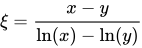
The logarithmic mean is obtained as the value of by substituting  for
for  and similarly for its corresponding derivative:
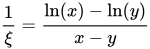
and solving for :
IntegrationEdit
The logarithmic mean can also be interpreted as the area under an exponential curve.
![{\displaystyle {\begin{aligned}L(x,y)={}&\int _{0}^{1}x^{1-t}y^{t}\ \mathrm {d} t={}\int _{0}^{1}\left({\frac {y}{x}}\right)^{t}x\ \mathrm {d} t={}x\int _{0}^{1}\left({\frac {y}{x}}\right)^{t}\mathrm {d} t\\[3pt]={}&\left.{\frac {x}{\ln \left({\frac {y}{x}}\right)}}\left({\frac {y}{x}}\right)^{t}\right|_{t=0}^{1}={}{\frac {x}{\ln \left({\frac {y}{x}}\right)}}\left({\frac {y}{x}}-1\right)={}{\frac {y-x}{\ln \left({\frac {y}{x}}\right)}}\\[3pt]={}&{\frac {y-x}{\ln \left(y\right)-\ln \left(x\right)}}\end{aligned}}}](https://wikimedia.org/api/rest_v1/media/math/render/svg/834a3d1b2267cb6d782f1542ced8616b209e17c0)
The area interpretation allows the easy derivation of some basic properties of the logarithmic mean. Since the exponential function is monotonic, the integral over an interval of length 1 is bounded by  and
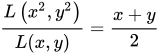
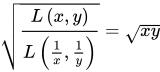
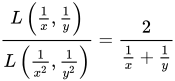
and  . The homogeneity of the integral operator is transferred to the mean operator, that is
  .
.
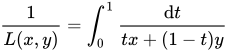
Two other useful integral representations are

Mean value theorem of differential calculusEdit
One can generalize the mean to  variables by considering the mean value theorem for divided differences for the
  th derivative of the logarithm.
We obtain
![{\displaystyle L_{\text{MV}}(x_{0},\,\dots ,\,x_{n})={\sqrt[{-n}]{(-1)^{(n+1)}n\ln \left(\left[x_{0},\,\dots ,\,x_{n}\right]\right)}}}](https://wikimedia.org/api/rest_v1/media/math/render/svg/a3f768d4332d13acc1ed2bef32032c7fd92c84bc)
where ![{\displaystyle \ln \left(\left[x_{0},\,\dots ,\,x_{n}\right]\right)}](https://wikimedia.org/api/rest_v1/media/math/render/svg/7456e6367275d5f13829e0150ea009b5b093bb38) denotes a divided difference of the logarithm.
denotes a divided difference of the logarithm.
For  this leads to
 .
.
IntegralEdit
The integral interpretation can also be generalized to more variables, but it leads to a different result. Given the simplex  with
with  and an appropriate measure
  which assigns the simplex a volume of 1, we obtain

This can be simplified using divided differences of the exponential function to
![{\displaystyle L_{\text{I}}\left(x_{0},\,\dots ,\,x_{n}\right)=n!\exp \left[\ln \left(x_{0}\right),\,\dots ,\,\ln \left(x_{n}\right)\right]}](https://wikimedia.org/api/rest_v1/media/math/render/svg/a0beb3a5bfda4ba6e6185d83ddf13c718d7a590c) .
.
Example 
 .
.
Connection to other meansEdit